
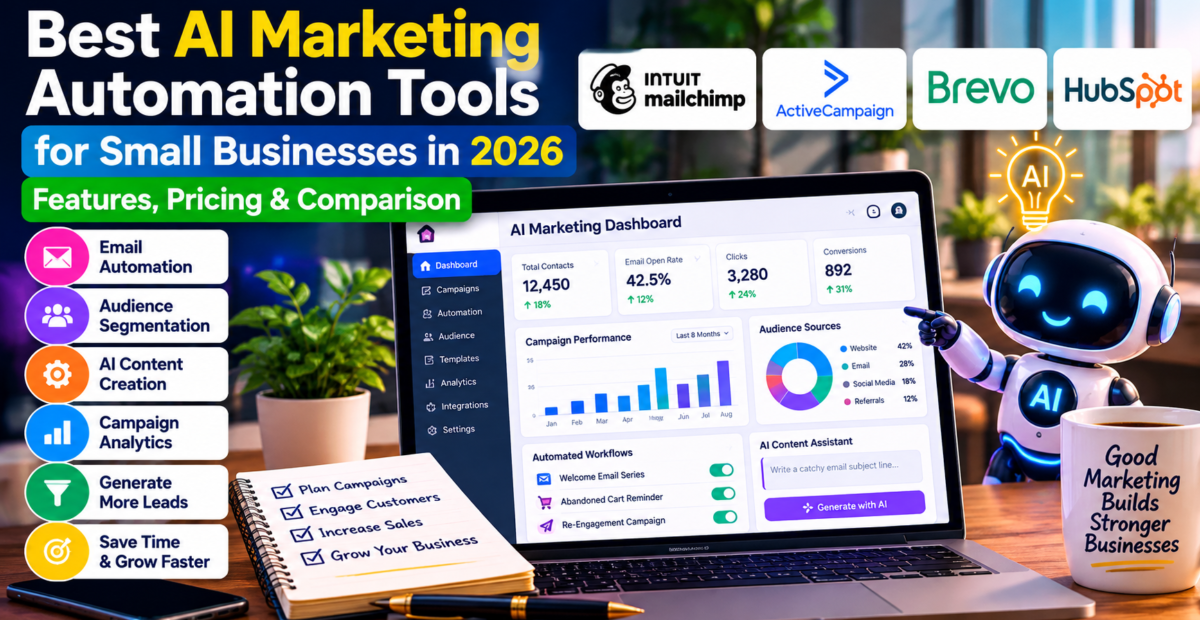
Best AI Marketing Automation Tools for Small Businesses in 2026: Features, Pricing & Comparison
 By Pixel Battle Arena Editorial Team
0 Comments
By Pixel Battle Arena Editorial Team
0 Comments
Last Updated: October 14, 2026
Marketing is an essential part of growing a small business, but managing marketing activities can quickly become overwhelming. Business owners often need to create email campaigns, respond to potential customers, organize contact lists, track campaign results, and prepare promotional content.
Completing these activities manually can take hours every week.
Fortunately, AI marketing automation tools for small businesses can help simplify repetitive marketing tasks and improve how companies communicate with their customers.
Modern marketing automation software combines email marketing, customer segmentation, workflow automation, analytics, and artificial intelligence. These features can help businesses deliver relevant messages, organize campaigns, and understand customer engagement.
However, choosing the right platform requires careful consideration. Marketing software providers offer different pricing structures, automation limits, AI capabilities, and customer management features.
In this guide, we compare four established platforms: Mailchimp, ActiveCampaign, Brevo, and HubSpot Marketing Hub.
We explain their features, pricing, benefits, limitations, and practical applications so small business owners can make informed decisions.
What Are AI Marketing Automation Tools?
AI marketing automation tools are software platforms that combine automated marketing workflows with artificial intelligence capabilities.
Traditional marketing automation follows predefined instructions.
For example, a business can create an email workflow that automatically sends a welcome message whenever someone subscribes to its newsletter.
Another workflow may send an appointment reminder or a follow-up message after a customer makes a purchase.
AI-powered marketing features can add capabilities such as generating email drafts, suggesting subject lines, identifying audience segments, analyzing campaign performance, and recommending delivery times.
These capabilities can reduce certain administrative tasks and help marketers work more efficiently.
However, artificial intelligence does not guarantee successful marketing results.
Businesses must still understand their customers, produce useful content, protect personal information, and review AI-generated messages before publishing them.
The most effective marketing automation system is one that supports a clear business strategy rather than simply automating as many activities as possible.
Why Small Businesses Need Marketing Automation Software
Small businesses frequently operate with limited marketing budgets and small teams.
A business owner may manage customer communication, social media content, email marketing, and promotional campaigns without dedicated marketing employees.
Marketing automation can help organize these responsibilities.
Save Time on Repetitive Activities
Email sequences, newsletter scheduling, customer notifications, and campaign reporting can involve repeated manual work.
Automation software can perform selected activities according to predefined rules.
For example, a business might create a welcome email sequence that introduces its services to new subscribers over several days.
Once the sequence is configured and tested, it can operate without requiring employees to send every message manually.
Improve Customer Communication
Marketing automation can help businesses deliver information when it is relevant to the customer.
A company might send useful product information after a customer requests a guide or subscribes to a specific newsletter.
This approach can improve communication consistency.
However, businesses should respect customer preferences and avoid excessive promotional messages.
Organize Customer Information
Many marketing platforms store contact information and record interactions such as email subscriptions, campaign engagement, and customer preferences.
Organized information helps businesses understand which audiences are interested in specific products or services.
Support Data-Driven Decisions
Reporting tools can help marketers examine email delivery, clicks, conversions, and other activities.
AI-powered reporting features may assist with identifying patterns or summarizing results.
Businesses should evaluate meaningful outcomes rather than relying on a single engagement metric.
Best AI Marketing Automation Tools for Small Businesses in 2026
The following platforms offer different approaches to email marketing, customer engagement, AI assistance, and workflow automation.
1. Mailchimp — Best for Email Marketing and Beginner-Friendly Campaigns
Mailchimp is an established marketing platform that helps businesses create email campaigns, manage subscribers, and build automated customer journeys.
It provides email design tools, audience management, reporting features, and integrations with other business applications.
Mailchimp can be useful for businesses that want to start with email marketing and gradually introduce more advanced campaign features.
For example, an online clothing store might use Mailchimp to send product announcements, welcome emails, seasonal promotions, and customer newsletters.
Its AI-related capabilities include content assistance and selected optimization features, depending on the subscription.
Important Features
Mailchimp provides drag-and-drop email creation, subscriber management, marketing automation, audience segmentation, reporting, and campaign templates.
Higher subscription tiers provide additional automation, personalization, and testing capabilities.
Its generative AI tools can assist with selected content creation tasks, but availability varies by plan and eligibility.
Mailchimp Pricing in 2026
Mailchimp provides several marketing plans.
The Free plan is available for up to 250 contacts, subject to its sending limits.
Essentials starts at approximately $13 per month for the entry-level contact tier.
Standard starts at approximately $20 per month and includes additional automation and optimization capabilities.
Premium begins at approximately $350 per month and is designed for businesses requiring more extensive features and support.
Pricing depends on contact volume, plan selection, and applicable promotional offers.
Advantages
Mailchimp offers an accessible email editor, templates, subscriber management, and an established ecosystem of marketing integrations.
Limitations
Advanced automation and personalization often require higher plans. Subscription costs may increase as the contact list grows.
Best For: Small businesses, bloggers, online stores, and beginners who want a platform focused on email marketing.
Official website: https://mailchimp.com/
2. ActiveCampaign — Best for Advanced Marketing Automation
ActiveCampaign focuses on email marketing, marketing automation, customer engagement, and CRM-related functionality.
It provides tools for building automated workflows based on contact information, customer actions, and predefined conditions.
One of its main strengths is the ability to create more sophisticated customer communication sequences.
For example, a small software company might send different onboarding emails depending on which product a new customer purchases.
A marketing agency could organize campaigns based on audience interests and engagement.
ActiveCampaign also provides AI-supported capabilities designed to assist with marketing content and automation workflows.
Important Features
ActiveCampaign includes email marketing, automated workflows, contact segmentation, reporting, and integration options.
Its more advanced subscriptions offer expanded automation actions, landing pages, deeper segmentation, and additional intelligent marketing features.
The platform also provides an AI-powered automation builder and other Active Intelligence capabilities, with usage limits depending on the plan.
ActiveCampaign Pricing in 2026
For an entry-level contact allowance of approximately 1,000 contacts, its published starting prices include:
| Plan | Starting Monthly Price |
|---|---|
| Starter | $15 |
| Plus | $49 |
| Pro | $79 |
The final price depends on billing terms, selected contact limits, and additional services.
The Starter plan includes limited automation actions, while Plus supports more advanced workflows.
Advantages
ActiveCampaign provides flexible workflow automation, customer segmentation, and advanced marketing capabilities.
Limitations
Complex automation requires planning and testing. Higher subscriptions may be necessary for certain AI, segmentation, and reporting functions.
Best For: Marketing agencies, online businesses, service providers, and growing companies that need sophisticated automated campaigns.
Official website: https://www.activecampaign.com/
3. Brevo — Best for Budget-Conscious Email Marketing
Brevo is a marketing platform that provides email campaigns, automation, customer communication, and related marketing services.
It offers different subscription levels designed for individuals, small businesses, and larger organizations.
Brevo can be an attractive option for smaller companies that want to begin with a free or relatively affordable email marketing service.
For example, a local service business might use Brevo to communicate with newsletter subscribers, announce promotions, and manage customer messages.
Brevo also offers AI-powered marketing capabilities through its Aura AI technology.
Selected functions include content assistance, segmentation support, and intelligent send-time optimization.
Important Features
Brevo offers an email campaign builder, contact management, templates, forms, reporting, and marketing automation.
More advanced plans provide expanded multi-step workflows, testing, and additional reporting capabilities.
Its AI features are not identical across all plans.
Brevo Pricing in 2026
Brevo provides a Free plan with up to 300 email sends per day.
Its Starter plan begins at approximately $9 per month for the lowest advertised paid sending tier.
The Standard plan costs more and includes additional automation functionality.
The total price depends on monthly email volume, billing preferences, and selected features.
Advantages
Brevo offers a free starting option, email-based pricing tiers, and tools suitable for smaller marketing operations.
Limitations
The Free plan includes daily sending restrictions. Businesses requiring advanced workflows or additional capabilities may need to upgrade.
Best For: Freelancers, small service businesses, newsletter publishers, and budget-conscious companies.
Official website: https://www.brevo.com/
4. HubSpot Marketing Hub — Best for Integrated Marketing and CRM
HubSpot Marketing Hub is part of HubSpot’s wider customer platform.
It combines marketing tools with customer relationship management, sales, reporting, and other business functions.
HubSpot can be particularly useful for businesses that want marketing activities connected to a centralized customer database.
For example, a consulting company could collect leads through a website form, manage contact details in its CRM, and coordinate marketing follow-ups.
HubSpot also provides AI-powered capabilities through selected platform products and services.
However, advanced marketing automation and AI agents may require additional subscriptions or credits.
Important Features
HubSpot Marketing Hub includes contact management, marketing emails, forms, reporting, and selected lead generation tools.
Higher subscriptions provide more advanced customer journey automation, campaign management, analytics, and additional marketing functionality.
HubSpot Marketing Hub Pricing in 2026
HubSpot offers free tools for up to two users.
Its Starter offering is advertised from approximately $7 per seat per month under eligible promotional pricing, while the regular displayed entry price is higher.
Marketing Hub Professional begins at approximately $800 per month under the selected annual commitment shown on its pricing page.
Professional onboarding carries a separate one-time fee.
Enterprise subscriptions are substantially more expensive.
Businesses should distinguish discounted entry-level offers from the regular cost of higher-tier marketing automation.
Advantages
HubSpot provides CRM integration, broad marketing capabilities, lead management, and opportunities to combine several business operations within one platform.
Limitations
Advanced marketing automation can be expensive for smaller businesses. Pricing may include marketing contact limits, onboarding charges, and AI-related usage credits.
Best For: Growing companies that want marketing, sales, and customer management tools in an integrated system.
Official website: https://www.hubspot.com/
AI Marketing Automation Software Pricing Comparison
The following table compares selected entry-level offerings.
| Software | Free Option | Paid Starting Price | Primary Strength |
|---|---|---|---|
| Mailchimp | Yes, limited contacts | Approximately $13/month | Email campaigns and newsletters |
| ActiveCampaign | Free trial | Approximately $15/month | Advanced workflow automation |
| Brevo | Yes, 300 emails/day | Approximately $9/month | Affordable email marketing |
| HubSpot Marketing Hub | Free marketing tools | Promotional Starter from approximately $7/seat/month | CRM and marketing integration |
Prices are based on published US-dollar information available in October 2026. These are not equivalent automation packages. Plan limitations, contacts, email volume, promotional eligibility, annual commitments, AI credits, and taxes can significantly affect total costs.
How to Choose the Best AI Marketing Automation Software
Choosing the right marketing automation platform requires more than comparing monthly subscription prices.
A business should first identify its goals and understand which marketing activities need improvement.
Define Your Marketing Goals
Some businesses mainly want to send newsletters.
Others need automated lead nurturing, customer segmentation, e-commerce follow-ups, or integrated CRM workflows.
These requirements may involve different software capabilities.
For example, a freelance consultant may only need a simple email welcome sequence.
A growing online store may require more advanced customer journeys and reporting.
Understand Your Contact List
Many marketing platforms calculate their prices according to the number of contacts stored in an account.
Some also impose limits on the number of emails that can be sent.
Businesses should consider both their current audience size and likely future growth.
Review Automation Features
Not every plan includes advanced automation.
Some entry-level subscriptions support only basic workflows, while higher plans offer conditional logic, multiple branches, and more complex customer journeys.
Before purchasing, check whether the selected plan supports the exact workflow your business needs.
Evaluate AI Features
AI marketing capabilities may include writing assistance, audience recommendations, campaign summaries, and send-time optimization.
Businesses should confirm which functions are included in their subscription.
AI features may have usage restrictions or require additional credits.
Compare Integrations
The software should connect with essential applications already used by the business.
These may include CRM platforms, e-commerce systems, website forms, scheduling applications, and reporting tools.
Consider Data Privacy
Businesses handling customer contact information must follow applicable privacy and marketing laws.
This may include obtaining appropriate consent, maintaining accurate records, and providing unsubscribe options.
The platform should offer suitable tools for managing subscriber preferences.
Practical AI Marketing Automation Examples for Small Businesses
Marketing automation is most useful when it solves a specific business problem.
Automated Welcome Email Sequences
When someone subscribes to a newsletter, a business can automatically send a welcome message.
A follow-up sequence might introduce available services, explain useful resources, and invite the subscriber to explore relevant products.
An AI writing assistant may help prepare initial email drafts.
Employees should review the messages for accuracy and tone before activating the sequence.
Customer Segmentation
A business may have customers interested in different products or services.
Marketing software can organize contacts according to selected attributes or activities.
For example, a software company might separate subscribers interested in accounting tools from those interested in project management.
AI-assisted segmentation can provide additional suggestions, but the business should evaluate whether those groups are meaningful.
Appointment Reminder Campaigns
A service provider may use automation to remind customers about appointments or scheduled consultations.
These messages can reduce repetitive administrative effort.
Transactional reminders and promotional campaigns may be subject to different rules, so businesses should configure them appropriately.
Online Store Follow-Ups
An online store can use automation to send order-related information or request feedback after an eligible purchase.
Some platforms also support abandoned-cart workflows.
Businesses should review consent requirements and avoid sending unwanted promotional messages.
Campaign Reporting
Marketing automation platforms can organize campaign statistics and highlight selected results.
AI analysis tools may help summarize trends or identify possible opportunities.
However, open rates and clicks do not always provide a complete picture of campaign performance.
Businesses should consider conversions, revenue, customer feedback, and overall marketing costs.
How Much Does AI Marketing Automation Cost for a Small Business?
The total cost depends on several factors.
These include contact volume, monthly email sends, selected features, AI usage, the number of employees, and required integrations.
A business using a simple email marketing platform may have a relatively low monthly subscription expense.
More advanced customer journey automation can cost substantially more.
For example, suppose a company subscribes to a $25-per-month marketing platform and pays another $15 per month for an additional integration service.
Its combined recurring software expense would be $40 per month.
Over 12 months, that would equal $480, excluding taxes, usage charges, and potential price changes.
The business should evaluate whether the software reduces manual work, improves customer communication, or supports measurable commercial goals.
Automation should not be considered profitable merely because it completes tasks automatically.
AI Email Marketing vs. Traditional Email Marketing
Traditional email marketing mainly involves creating and sending messages to subscribers.
AI-assisted email marketing adds intelligent features that help marketers prepare, organize, or analyze campaigns.
| Feature | Traditional Email Marketing | AI-Assisted Marketing |
|---|---|---|
| Newsletter sending | Yes | Yes |
| Scheduled campaigns | Yes | Yes |
| Automated email sequences | Available | Available |
| AI writing assistance | Usually not included | Available on selected plans |
| Intelligent audience suggestions | Limited | Possible |
| Send-time optimization | Available on some platforms | May use predictive AI |
| Human review | Necessary | Necessary |
AI marketing tools can assist with campaign development, but human oversight remains essential.
Businesses should verify claims, product details, pricing, and promotional messages before contacting customers.
Important Benefits of Marketing Automation
Consistent Communication
Automation allows businesses to maintain a predictable communication process.
For example, a new subscriber may receive an introductory message without waiting for someone to manually send it.
Better Organization
Customer preferences, campaign history, and audience information can be stored in a structured system.
This helps employees coordinate marketing activities more efficiently.
Reduced Manual Administration
Automated workflows can reduce repetitive actions such as assigning contacts to lists or sending scheduled notifications.
Improved Campaign Testing
Some platforms allow businesses to test subject lines, messaging, and other campaign elements.
Results can help marketers understand which approaches work better for their audience.
More Relevant Messaging
Segmentation and personalization tools may help businesses deliver content related to customer interests.
However, personalization must be implemented responsibly and should respect privacy preferences.
Common Mistakes to Avoid With AI Marketing Software
One common mistake is purchasing an expensive platform before developing a clear marketing strategy.
Automation tools cannot compensate for unclear messaging or an unsuitable product.
Another mistake is collecting contact information without proper permission.
Sending unsolicited promotional messages can harm customer trust and violate applicable rules.
Businesses should also avoid relying entirely on AI-generated content.
AI can produce incorrect product descriptions, misleading claims, or unnatural wording.
Every campaign should be checked before publication.
Another frequent problem is creating complicated automation workflows too early.
A small business may benefit more from one reliable welcome sequence than from several poorly configured campaigns.
Finally, businesses should review usage charges and subscription renewals.
A growing contact list may increase monthly marketing software costs.
How to Start AI Marketing Automation Step by Step
A successful implementation begins with a simple process.
Step 1: Identify one marketing objective.
Choose a measurable goal, such as organizing newsletter subscriptions or improving customer follow-up.
Step 2: Select a suitable platform.
Compare supported features, pricing, integrations, and limits.
Step 3: Prepare your contact list.
Use customer information obtained through appropriate permission and maintain accurate subscriber records.
Step 4: Create one automation workflow.
Start with a welcome email or another low-risk process.
Step 5: Add useful content.
Prepare messages that offer genuine information rather than unnecessary promotional language.
Step 6: Test the workflow.
Check triggers, email formatting, links, unsubscribe functionality, and delivery settings.
Step 7: Monitor performance.
Review results over time and identify areas requiring improvement.
Step 8: Expand gradually.
Introduce more advanced AI and automation features when they address a proven business need.
Is AI Marketing Automation Worth It for Small Businesses?
AI marketing automation can be worthwhile when it reduces repetitive work and supports meaningful customer communication.
However, the value depends on the company’s requirements, available budget, and ability to manage the software.
A small business with a limited mailing list may only need basic email marketing tools.
A company managing thousands of contacts and multiple customer journeys may benefit from more sophisticated automation.
Business owners should evaluate the total cost rather than relying solely on promotional claims about increased sales or improved productivity.
The best solution is often the one that supports essential activities without introducing unnecessary complexity.
Future of AI Marketing Automation
Marketing software providers continue introducing AI capabilities.
These developments include AI-assisted content generation, predictive segmentation, automated campaign preparation, and intelligent customer engagement tools.
Some platforms also offer AI agents designed to help manage selected activities.
As these technologies evolve, businesses may gain access to increasingly sophisticated automation.
However, accuracy, privacy, security, and customer consent will remain important considerations.
Companies should adopt AI features based on practical value rather than assuming that newer technology automatically delivers better results.
Frequently Asked Questions
What are the best AI marketing automation tools for small businesses?
Mailchimp, ActiveCampaign, Brevo, and HubSpot Marketing Hub are established platforms worth comparing. The best choice depends on marketing objectives, budget, automation requirements, and integrations.
Is AI marketing automation expensive?
Not necessarily. Some platforms offer free plans or relatively affordable entry-level subscriptions. Advanced automation, larger contact lists, and AI features may increase costs.
Can AI automate email marketing?
Yes. Marketing platforms can automate approved email sequences, subscriber management, and selected campaign activities. AI may assist with drafting messages, segmentation, or optimization.
Which marketing automation platform is best for beginners?
Mailchimp and Brevo can be useful starting points for businesses focusing on basic email campaigns. Beginners should compare free-plan restrictions and test the software before upgrading.
Is ActiveCampaign better than Mailchimp?
ActiveCampaign may appeal to businesses requiring more advanced workflow automation. Mailchimp may suit users prioritizing email creation and straightforward campaign management. The right choice depends on specific requirements.
Does HubSpot offer free marketing automation?
HubSpot provides free marketing tools, but advanced workflow automation and certain AI capabilities require paid products or additional allowances.
Can AI marketing tools increase sales?
They can support customer communication, lead nurturing, and campaign organization. However, they do not guarantee higher sales or revenue.
What is the difference between CRM and marketing automation?
CRM software primarily organizes customer relationships and sales information. Marketing automation software focuses on campaigns, audience communication, and automated marketing activities. Some platforms combine both.
Is AI-generated marketing content safe to publish?
AI-generated drafts should be reviewed before publication. Businesses must check factual accuracy, product claims, brand tone, and legal or advertising requirements.
How do small businesses start marketing automation?
Start with one objective, choose suitable software, create an authorized contact list, configure a simple workflow, and test it before expanding.
Final Thoughts
AI marketing automation tools for small businesses can help companies organize campaigns, reduce repetitive tasks, and communicate more consistently with customers.
Mailchimp offers accessible email marketing functionality. ActiveCampaign provides more advanced workflow capabilities. Brevo offers affordable starting options, while HubSpot Marketing Hub combines marketing with a broader customer management platform.
Before selecting software, compare regular pricing, contact limits, automation features, AI availability, integrations, and data privacy controls.
A successful marketing automation strategy depends on understanding customer needs and delivering useful communication.
AI can support that process, but it should complement human judgment rather than replace it.
For more practical business technology guides, explore the AI Marketing Tools and AI Business Automation categories on Pixel Battle Arena.
Editorial Note: This article provides general educational information. Pricing and feature details are based on publicly available provider documentation, not independent hands-on testing. Software plans and AI functionality may change.
Official Sources
- Mailchimp Pricing: https://mailchimp.com/pricing/marketing/
- ActiveCampaign Pricing: https://www.activecampaign.com/pricing/
- Brevo Pricing: https://www.brevo.com/pricing/
- HubSpot Marketing Hub Pricing: https://www.hubspot.com/pricing/marketing
