
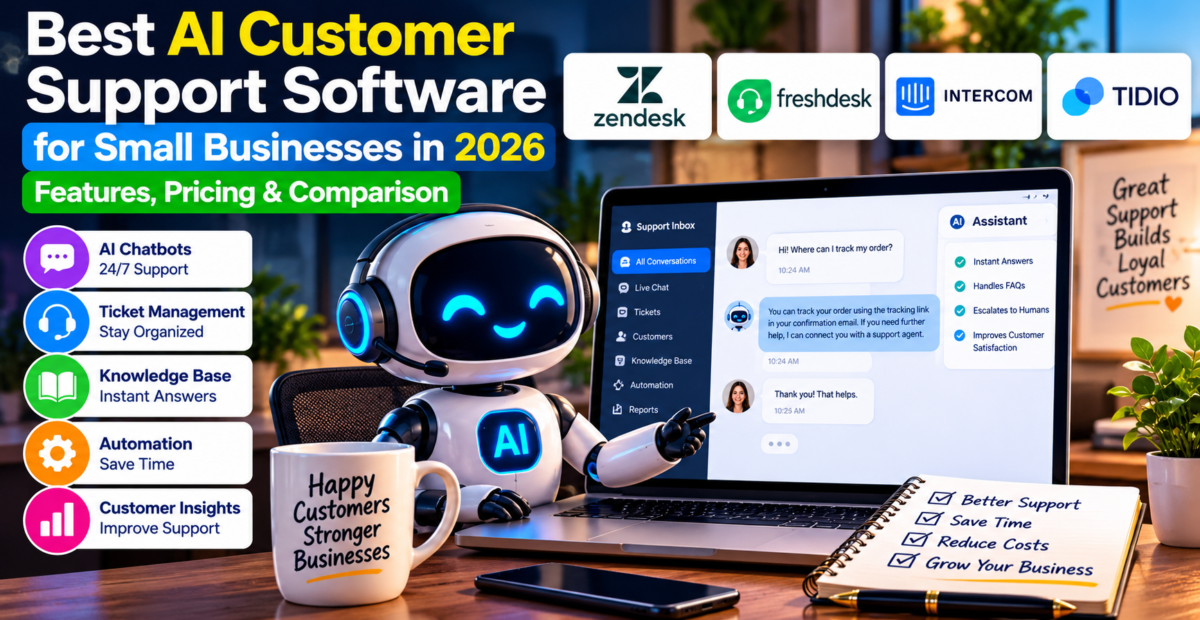
Best AI Customer Support Software for Small Businesses in 2026: Features, Pricing & Comparison
 By Pixel Battle Arena Editorial Team
0 Comments
By Pixel Battle Arena Editorial Team
0 Comments
Last Updated: October 14, 2026
Providing excellent customer service is one of the most important responsibilities of any business. Customers expect clear answers, timely responses, and helpful assistance when they experience a problem. However, handling customer inquiries through email, live chat, social media, and website contact forms can become difficult for a small team.
This is where AI customer support software for small businesses can help.
Modern customer support platforms combine help desk ticketing, live chat, knowledge bases, workflow automation, and artificial intelligence. These tools can organize customer conversations, automate repetitive questions, and help employees respond more efficiently.
For example, a small online store may receive dozens of questions about delivery times, returns, and order updates every day. An AI customer service chatbot can answer certain routine questions using approved information while sending more complicated issues to a human employee.
However, not all AI customer support systems offer the same functionality. Some focus on support tickets, while others specialize in conversational AI, website chatbots, or automated customer service.
Pricing also varies significantly. Certain platforms charge for each employee, while others charge according to AI conversations, sessions, or successfully completed outcomes.
In this guide, we compare four established customer service platforms: Zendesk, Freshdesk, Intercom, and Tidio.
We explore their features, pricing, benefits, limitations, and practical uses so small business owners can make informed decisions.
What Is AI Customer Support Software?
AI customer support software is a type of business application that uses artificial intelligence to help manage customer service activities.
Traditional customer support software allows businesses to receive questions, create support tickets, assign requests to employees, and track customer conversations.
AI-powered software adds intelligent capabilities such as automatic ticket classification, suggested responses, conversation summaries, and answers generated from approved knowledge sources.
Some platforms offer AI agents capable of completing selected customer service workflows.
For example, a customer visiting an online store might ask about its refund policy.
An AI agent can search an approved knowledge base and explain the published return conditions.
If the customer needs help with a payment dispute or a complicated refund, the system may transfer the conversation to a human support representative.
The goal is to improve service efficiency without reducing accuracy, security, or customer trust.
Businesses should remember that AI-generated responses can contain mistakes. Human supervision remains important, especially when handling financial information, account security, personal data, and sensitive customer complaints.
Why Small Businesses Need AI Customer Service Automation
Small businesses often operate with limited customer support resources.
A company may have only one or two employees responsible for answering emails, managing orders, responding to customer inquiries, and handling complaints.
As customer activity increases, maintaining consistent service becomes more difficult.
AI customer service automation can help address several common challenges.
Faster Answers to Routine Questions
Customers frequently ask similar questions about business hours, product availability, shipping policies, and appointment procedures.
A properly configured chatbot may answer these questions without requiring a human employee for every interaction.
Better Organization of Support Requests
Help desk software can collect customer requests and organize them in one location.
Support tickets can be assigned to employees, labeled according to their topics, and tracked until they are resolved.
Reduced Repetitive Work
Automation can help send acknowledgments, update ticket statuses, and route inquiries.
AI assistants may also summarize long conversations or prepare response drafts.
Improved Support Availability
AI chatbots can provide certain types of assistance outside normal business hours.
However, businesses should clearly explain when human support is available and avoid suggesting that automated assistance can resolve every problem.
More Useful Customer Insights
Support software often includes reporting tools that help businesses understand request volumes, response times, and recurring customer issues.
These insights can identify areas where business processes or published information need improvement.
Best AI Customer Support Software for Small Businesses in 2026
The following platforms offer different approaches to customer service management and AI support automation.
1. Zendesk — Best for Structured Help Desk and Ticket Management
Zendesk is a customer service platform that helps businesses manage support requests across different communication channels.
It offers ticketing, messaging, knowledge management, reporting, and automation features.
Zendesk is particularly relevant to businesses that need organized customer service processes.
For example, a growing online store could use Zendesk to manage support emails, customer complaints, and website inquiries.
Employees can view conversations, assign tickets, and track the progress of each request.
Zendesk also offers AI capabilities for automated customer assistance, ticket routing, and agent productivity.
Important Zendesk Features
Zendesk provides a centralized ticketing system that helps organize customer requests.
Its messaging capabilities support communication through selected digital channels.
Knowledge base functionality allows businesses to publish helpful articles that answer common customer questions.
AI agents can assist with selected customer inquiries, while automation rules help organize and route support requests.
Higher plans provide additional reporting, administration, and workflow capabilities.
Zendesk Pricing in 2026
Zendesk publishes several customer support subscription options.
Its Support Team plan starts at $19 per agent per month with annual billing.
Suite Team starts at $55 per agent per month, while Suite Professional starts at $115 per agent per month with annual billing.
Monthly billing is more expensive.
Businesses should note that the basic Support Team plan is not equivalent to the more comprehensive Suite plans.
Certain advanced AI capabilities, voice services, or additional usage may require separate charges.
Advantages
Zendesk provides structured ticket management, multiple service tools, reporting, and options for businesses with growing support teams.
Limitations
The total subscription cost may increase with employee count and additional AI requirements. More advanced functions can require higher plans.
Best For: Growing companies, online stores, and businesses managing support requests across several channels.
Official website: https://www.zendesk.com/
2. Freshdesk — Best for Email Support and AI-Assisted Help Desk Operations
Freshdesk is a customer support platform developed by Freshworks.
It helps businesses manage customer requests, support tickets, shared inboxes, knowledge bases, and service workflows.
Freshdesk can be useful for small companies that receive many customer service emails and need a more organized system.
For example, a software business might use Freshdesk to receive technical questions, assign them to the appropriate employee, and track their resolution.
Freshdesk also provides Freddy AI capabilities for automated customer assistance and agent productivity.
Important Freshdesk Features
Freshdesk includes support ticket management, a shared inbox, customer portals, knowledge base tools, and reporting.
Automation capabilities can help assign tickets and organize customer inquiries.
Freddy AI Agent supports selected automated customer service interactions.
Freddy AI Copilot offers agent-assistance features such as response drafting, conversation summarization, and related support functions.
The availability of these capabilities depends on the plan and applicable add-ons.
Freshdesk Pricing in 2026
Freshdesk’s email-focused help desk pricing includes:
| Plan | Price Per Agent/Month |
|---|---|
| Growth | $19 |
| Pro | $55 |
| Enterprise | $89 |
These prices are based on annual billing.
Freshdesk currently lists the first 500 Freddy AI Agent sessions as included in its relevant plans, with additional sessions available at $49 per 100 sessions.
Freddy AI Copilot is available as an additional paid service on eligible plans, with annual pricing starting at $29 per agent per month.
Businesses needing support across more channels should also compare Freshdesk Omni, which has a different pricing structure.
Advantages
Freshdesk offers organized support ticketing, automation capabilities, a customer portal, and AI assistance.
Limitations
Advanced AI functions and additional sessions can create extra costs. Companies should also distinguish between Freshdesk’s email-focused product and its omnichannel offerings.
Best For: Small support teams, software companies, service providers, and businesses primarily handling customer inquiries through email.
Official website: https://www.freshworks.com/freshdesk/
3. Intercom — Best for Conversational AI Customer Support
Intercom is a customer service platform that combines live chat, support inboxes, help centers, and AI-powered customer assistance.
Its AI agent is called Fin.
Fin is designed to answer customer questions using approved information and complete selected support processes.
For example, a subscription-based software company may receive questions about account settings, billing procedures, and product features.
Intercom can help organize these conversations and provide automated answers based on relevant support materials.
Fin can also transfer conversations to human employees when necessary.
Important Intercom Features
Intercom provides website and application messaging, customer support inboxes, ticket management, knowledge bases, and reporting tools.
Fin AI Agent can support automated responses and selected workflows.
More advanced plans provide expanded automation, routing, and team management capabilities.
Businesses should review supported communication channels and the requirements of the particular AI tasks they want to automate.
Intercom Pricing in 2026
Intercom currently lists the following annual-billing seat prices:
| Plan | Price Per Seat/Month |
|---|---|
| Essential | $29 |
| Advanced | $85 |
| Expert | $132 |
Fin AI Agent uses a separate outcome-based pricing model.
Standard qualifying outcomes, including certain successful resolutions, cost $0.99 each.
Some specialized qualification outcomes cost more.
Businesses may also use Fin with certain existing help desk platforms, subject to the applicable commercial terms and minimum commitments.
Advantages
Intercom offers conversational customer support, integrated messaging, and AI agents designed for customer service.
Limitations
Its total cost depends on both human support seats and AI outcomes. High conversation volumes or optional add-ons can increase expenses.
Best For: SaaS companies, subscription businesses, online services, and teams prioritizing conversational AI support.
Official website: https://www.intercom.com/
4. Tidio — Best for Small Business Website Chatbots
Tidio is a customer communication platform offering live chat, help desk tools, and chatbot automation.
It can be particularly useful for businesses that want to provide customer assistance directly through their websites.
Tidio’s AI agent is called Lyro.
Lyro can answer customer questions using business-provided knowledge and perform certain supported actions.
For example, a small online store could use Tidio to answer general shipping questions, explain store policies, or direct visitors toward relevant support resources.
If the customer needs further assistance, the conversation can be transferred to a human representative.
Important Tidio Features
Tidio provides website chat, ticket management, support inbox tools, automation flows, and customer communication features.
Lyro AI Agent supports knowledge-based responses and selected automated customer service activities.
The platform also includes options for collecting leads and improving customer communication through automated flows.
Tidio Pricing in 2026
Tidio offers a free customer service plan with limited monthly conversations.
Its Starter plan is advertised from approximately $24.17 per month with annual billing and includes 100 billable human conversations.
Growth starts at approximately $49.17 per month with annual billing.
Lyro AI Agent can be purchased separately, starting at approximately $32.50 per month with annual billing for 50 AI conversations.
The exact total depends on support volume, AI conversation allowances, and the selected billing arrangement.
Advantages
Tidio offers website-focused customer communication, a free starting option, chatbots, and automation features that may suit smaller businesses.
Limitations
Conversation limits can increase expenses as traffic grows. Businesses should understand the difference between human conversation allowances and AI conversation quotas.
Best For: Small online stores, service business websites, and companies wanting live chat with optional AI assistance.
Official website: https://www.tidio.com/
AI Customer Support Software Pricing Comparison
The following table summarizes entry-level pricing from the providers’ published plans.
| Software | Starting Paid Price | Pricing Model | Main Strength |
|---|---|---|---|
| Zendesk | $19/agent/month | Per support agent | Structured ticket management |
| Freshdesk | $19/agent/month | Per agent plus AI usage | Email help desk and automation |
| Intercom | $29/seat/month | Per seat plus AI outcomes | Conversational AI support |
| Tidio | $24.17/month | Conversation-based allowances | Website live chat and AI chatbot |
Prices are in US dollars and generally reflect annual billing. These plans do not include identical features or AI allowances. Intercom Fin, Freshdesk Freddy AI, Tidio Lyro, and certain Zendesk AI capabilities may involve additional charges. Figures checked October 14, 2026.
Understanding Different Customer Support Pricing Models
Comparing AI customer support software pricing can be confusing because providers do not all charge in the same way.
Some platforms use seat-based subscriptions.
Under this model, the business pays according to the number of employees who need access.
For example, a support team with five agents using a $20-per-agent subscription would pay $100 per month before any additional charges.
Other platforms charge based on AI usage.
An AI agent might cost a fixed amount per conversation, completed resolution, or session.
Suppose a business uses a support system charging $0.99 for a qualifying AI resolution.
If the system completes 100 billable resolutions during a month, that specific usage would cost $99.
This does not necessarily include the base software subscription, additional channels, or any other charges.
Businesses should estimate their normal customer service activity before selecting a plan.
Which AI Customer Support Software Is Best for Different Businesses?
Different business models require different customer service tools.
Best for Online Stores
E-commerce businesses often receive inquiries about delivery, order updates, payment methods, returns, and product availability.
Tidio may be worth evaluating for website chat and common customer questions.
Zendesk may be suitable when the business manages larger numbers of tickets across multiple channels.
Best for SaaS Companies
Software companies often need to answer technical questions and explain product features.
Intercom can be relevant to businesses that want conversational support within their websites or applications.
Freshdesk may also be useful for organizing technical support emails and managing a knowledge base.
Best for Freelancers
Freelancers may not need expensive help desk software.
A simple shared inbox, contact form, or entry-level live chat solution may be enough.
Tidio’s free option can be worth evaluating when website chat is the priority.
Best for Growing Customer Support Teams
Growing teams often need ticket assignment, reporting, access controls, and consistent support processes.
Zendesk and Freshdesk provide structured help desk capabilities worth comparing.
The best choice depends on support channels, employee count, workflow requirements, and available budget.
AI Chatbots vs. Traditional Customer Support Chatbots
Traditional chatbots often follow predefined decision trees.
For example, a customer selects an option labeled “Track My Order,” and the chatbot displays the next relevant step.
AI-powered chatbots can interpret more flexible customer questions and generate responses using approved information.
However, their capabilities depend on the underlying AI technology, available data, system permissions, and business configuration.
| Feature | Traditional Chatbot | AI Customer Support Agent |
|---|---|---|
| Predefined answers | Yes | Yes |
| Fixed conversation flows | Common | Optional |
| Flexible natural-language questions | Limited | Generally stronger |
| Knowledge-based responses | Available in some systems | Common |
| Automated customer actions | Rule-dependent | Available in selected products |
| Risk of incorrect answers | Present | Present |
| Human escalation | Can be configured | Can be configured |
Neither approach is automatically better for every task.
A simple rules-based chatbot may be sufficient for business hours and appointment instructions.
AI agents can be more useful for varied questions, provided they have reliable source information and appropriate controls.
How AI Customer Support Automation Works
A typical AI customer support workflow involves several stages.
First, a customer submits a question through a website, email, or supported messaging channel.
The system identifies the request and checks whether it can provide assistance.
An AI agent may search a knowledge base containing approved policies, instructions, and product information.
It then prepares a response based on that information.
If the request is too complicated, involves sensitive information, or requires human authorization, the system may transfer the conversation to an employee.
The support platform can retain the conversation history so the employee understands what the customer has already discussed.
Finally, reporting tools may record information about the interaction.
The business can use these records to identify unanswered questions and improve its support content.
Practical AI Customer Support Examples
Automated Answers for Shipping Questions
An online store receives repeated questions about standard shipping times.
A chatbot can use the store’s published shipping policy to answer general inquiries.
Customers needing information about a specific shipment may require an authenticated system connection or human assistance.
Customer Appointment Support
A service business can use automation to explain appointment procedures and available services.
Where suitable integrations exist, the system may also help schedule appointments.
Technical Support Questions
A software company can create a knowledge base explaining common issues.
An AI agent can use the approved material to guide customers through basic troubleshooting.
If the problem remains unresolved, it can direct the request to a technical support employee.
Automated Support Ticket Classification
Businesses can use AI to organize incoming support messages.
For example, a platform may categorize requests as billing, technical support, general inquiry, or account assistance.
An employee can then review the categorization before processing sensitive requests.
Customer Conversation Summaries
Long support conversations can be difficult to review.
AI-powered summarization may help employees understand previous interactions more quickly.
However, summaries should be checked against the original conversation when accuracy is important.
Can AI Customer Support Software Reduce Business Costs?
AI customer support software may reduce some repetitive administrative work.
For example, if customers regularly ask questions that are already answered in a company’s knowledge base, an AI agent may provide those answers without requiring an employee to respond manually every time.
However, cost savings are not guaranteed.
The total financial effect depends on subscription expenses, usage-based charges, implementation costs, support volume, and the accuracy of automated responses.
A business may also need to spend time preparing knowledge base articles, testing chatbot behavior, training employees, and maintaining integrations.
An incorrectly configured chatbot can create additional work if customers receive unsuitable answers.
Companies should evaluate actual outcomes rather than relying only on promises of lower support costs.
Important Features to Look for in AI Help Desk Software
Knowledge Base Integration
A support platform should provide a reliable way to connect approved information with automated responses.
The knowledge base should be updated when business policies or products change.
Human Handoff
Customers should have a clear way to reach human support when necessary.
This is especially important for complicated complaints, billing matters, or unusual problems.
Ticket Management
A structured ticketing system helps employees track open requests and understand which issues still need attention.
Multiple Support Channels
Some businesses need email support, while others require website chat, social messaging, or phone assistance.
Choose a system that supports the channels customers actually use.
Reporting and Analytics
Useful reports may include ticket volume, response times, resolution activity, and customer feedback.
Privacy and Security
Support systems may process names, addresses, account information, and other personal data.
Businesses should review access controls, retention policies, permissions, and applicable privacy requirements.
Clear Usage Pricing
Understand how conversations, sessions, seats, AI outcomes, and additional services are billed.
Unexpected usage costs can make an otherwise affordable platform unsuitable.
Common Mistakes When Using AI Customer Support Software
One mistake is launching an AI chatbot without providing accurate business information.
If the knowledge base is incomplete, automated responses may be unhelpful or incorrect.
Another mistake is making human support difficult to access.
Customers should not be trapped in repeated automated conversations when a person is needed.
Businesses should also avoid connecting AI agents to sensitive systems without suitable permissions and safeguards.
For example, payment adjustments, account changes, and refunds may require identity verification and human approval.
Another problem is ignoring customer feedback.
A chatbot may appear successful based on usage statistics while customers remain dissatisfied.
Businesses should evaluate both quantitative reports and actual customer experiences.
Finally, companies should review the total cost of AI automation.
High usage may lead to additional charges under conversation-based or outcome-based models.
How to Set Up AI Customer Support Software
Step 1: Identify common customer questions. Review existing support emails, contact forms, and customer feedback.
Step 2: Select a suitable platform. Compare support channels, AI features, integration requirements, and pricing.
Step 3: Prepare a knowledge base. Write accurate answers to common questions about products, services, policies, and contact procedures.
Step 4: Configure support channels. Connect the website, email inbox, or other supported communication services.
Step 5: Set escalation rules. Decide which requests the AI can handle and which must go to a human employee.
Step 6: Test with realistic questions. Include simple, complicated, ambiguous, and unusual customer requests.
Step 7: Review privacy controls. Check how customer information is processed and who can access it.
Step 8: Launch gradually. Begin with routine, low-risk questions.
Step 9: Monitor performance. Review incorrect answers, unresolved requests, support costs, and customer feedback.
Step 10: Improve the system. Update knowledge materials and workflows as new customer needs emerge.
This gradual approach helps businesses identify problems before expanding automation.
Is AI Customer Support Software Worth It for Small Businesses?
AI customer support software can be useful when a business regularly receives repeated inquiries or needs more organized support processes.
However, the best solution is not always the platform with the most AI features.
A small company receiving only a few customer questions per week may not need an expensive automated support system.
A growing business managing hundreds of inquiries may benefit from more structured workflows, reporting, and selected automated responses.
Business owners should begin by estimating the actual number of support requests they receive.
They should also identify how much time employees spend on routine activities.
Then they can compare software costs with potential operational benefits.
AI should support a better customer experience rather than become a barrier between the customer and the business.
Future of AI Customer Service Automation
AI customer support technology continues to develop.
Software providers are introducing more capable AI agents, intelligent routing, conversation analysis, and workflow automation.
Some systems can interact with approved external applications and perform selected customer service actions.
These developments may help smaller businesses provide more consistent support.
However, businesses must also consider the risks of inaccurate responses, improper data access, and excessive automation.
Customer service is not simply about answering questions quickly.
It also involves understanding problems, providing fair solutions, and maintaining customer trust.
The most successful AI support strategies will combine useful automation with clear human responsibility.
Frequently Asked Questions
What is the best AI customer support software for small businesses?
The best option depends on business requirements. Zendesk offers structured help desk management, Freshdesk focuses on ticketing and support automation, Intercom provides conversational AI support, and Tidio offers website chat and chatbot capabilities.
Is AI customer support software expensive?
Costs vary considerably. Some platforms provide free or relatively affordable entry-level options, while advanced AI support systems may charge for employees, conversations, sessions, or outcomes.
Can AI chatbots answer customer questions automatically?
Yes. AI chatbots can answer selected customer questions using approved knowledge sources. However, businesses should monitor their responses and provide human assistance when necessary.
Is Zendesk better than Freshdesk?
Both provide help desk and automation tools. The better choice depends on support channels, reporting requirements, AI features, subscription costs, and team size.
Does Tidio have a free plan?
Yes. Tidio provides a free customer service option with limited conversation allowances. More extensive AI usage requires applicable paid allowances.
How much does Intercom Fin cost?
Intercom lists $0.99 for standard qualifying Fin outcomes, alongside applicable platform or commercial charges. Some specialized outcomes have different prices.
Can AI customer service replace employees?
AI can handle certain repetitive tasks, but human employees remain important for complicated issues, sensitive decisions, customer relationships, and quality control.
What is the difference between live chat and AI chatbots?
Live chat generally allows customers to communicate with a human representative. AI chatbots generate automated responses and may help resolve selected requests without immediate human involvement.
Can small businesses use AI customer support on WordPress?
Yes. Some providers offer WordPress integrations or embeddable website chat widgets. Businesses should verify plugin compatibility, performance, privacy implications, and pricing before installation.
How can a business improve AI chatbot accuracy?
Use reliable knowledge sources, keep information updated, test different questions, monitor unsuccessful responses, and ensure customers can reach human support.
Final Thoughts
AI customer support software for small businesses can help organize customer inquiries, reduce repetitive administration, and provide more consistent answers to routine questions.
Zendesk, Freshdesk, Intercom, and Tidio offer different approaches to help desk management, artificial intelligence, and customer communication.
Zendesk can suit businesses requiring structured ticketing. Freshdesk provides email-focused help desk capabilities and automation. Intercom specializes in conversational customer assistance, while Tidio can be useful for website chat and smaller support operations.
Before purchasing, compare the total cost, available AI features, customer communication channels, usage limits, and security requirements.
The best customer service solution is one that helps customers receive reliable assistance while keeping human support available when necessary.
For additional technology resources, explore the AI Customer Support and AI Business Automation guides on Pixel Battle Arena.
Editorial Note: This article provides general educational information. Software prices and capabilities are based on publicly available provider information rather than independent hands-on testing. Features, plan eligibility, AI usage costs, and regional pricing may change.
Official Sources
- Zendesk Pricing: https://www.zendesk.com/pricing/
- Freshdesk Pricing: https://www.freshworks.com/freshdesk/pricing/
- Intercom Pricing: https://www.intercom.com/pricing
- Tidio Pricing: https://www.tidio.com/pricing/
